

In the early 1970s, a planner at Royal Dutch Shell named Pierre Wack became convinced that the age of cheap, abundant oil was about to end. Problem was, he couldn’t prove it with data. What he had were fragments: rising assertiveness among oil-producing states, a US that had grown dependent on imports, a global economy that had never once imagined the tap being turned off. So Wack did something that wasn’t forecasting in the usual sense. He wrote the story of a world in which the oil shock had already happened, and he walked Shell’s executives through it until they could feel it.
When the embargo came in 1973 and prices quadrupled, nearly every major company was blindsided... except for Shell. Shell had already lived through it, on paper, and so it moved faster and more decisively than any of its rivals.
That is what a scenario is, at its core. Not an exact prediction, and not a guess dressed up in probabilities. A scenario is a disciplined, evidence-based story about a future that hasn’t happened yet, built well enough that the people who read it change how they think and what they do. The point was never to be right about a single outcome. The point was to make the unthinkable thinkable early enough to act on it.
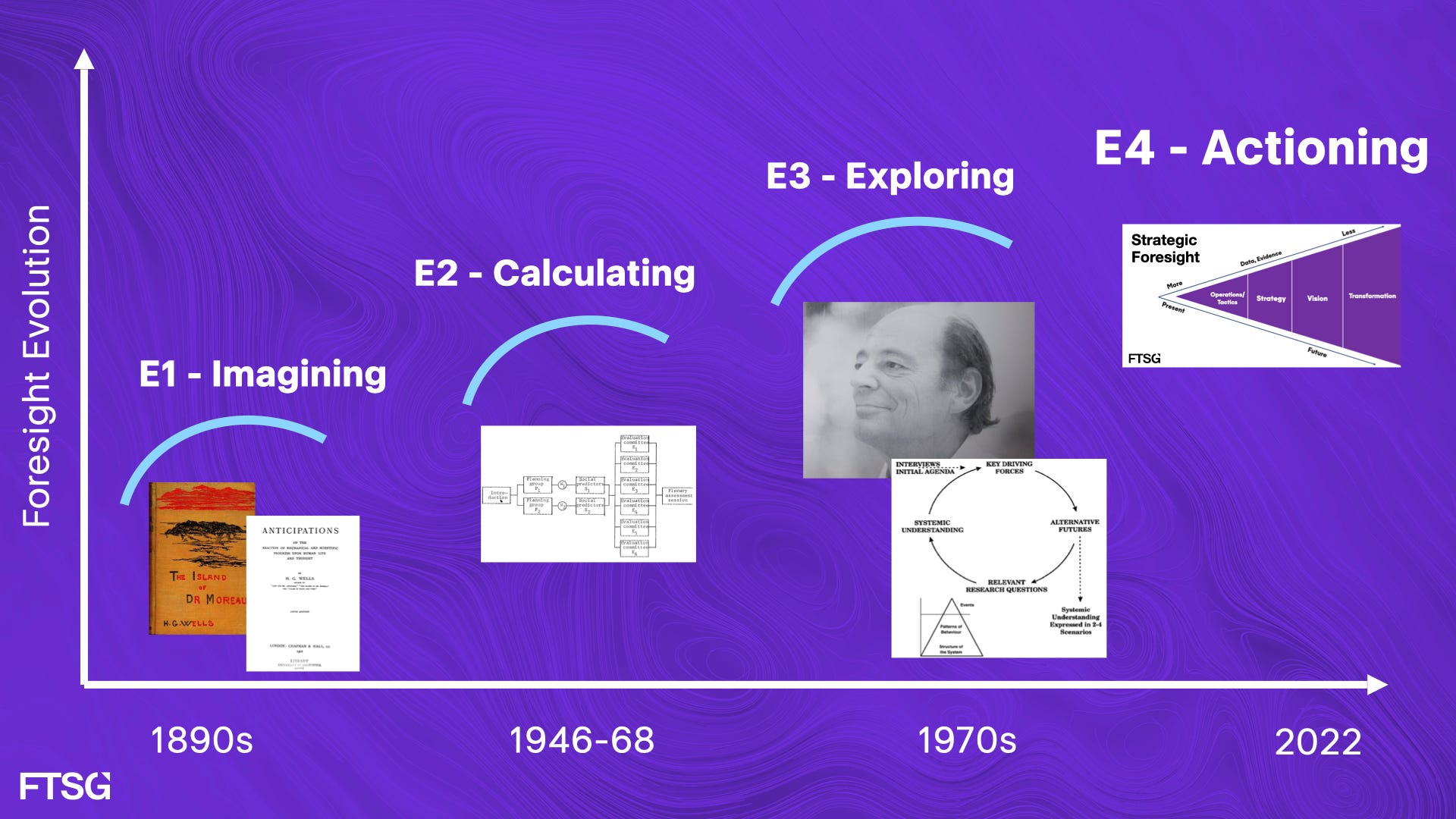
Wack didn’t invent scenarios of nothing, and neither did I. When I wrote The Signals Are Talking, I traced foresight back through a very long lineage of people who each figured out a new way of seeing.
I’ll skip ahead to modern(ish) day and H.G. Wells, who did deliberately what no one had done before: he took the faint signals of his own moment (like, electricity becoming a general purpose technology, the machinery of modern war taking shape), asked “what if?” He used that reporting to write stories vivid enough to make readers feel a future that wasn’t yet here. I call this the Imagining Era of foresight.
After WWII, Olaf Helmer and Nicholas Rescher at RAND turned foresight into something more systematic. They built probabilistic models and made the practice rigorous. But they stopped at the edge of recommendation. Their job, as they understood it, was to show you what might happen, not to help you do anything about it. I call this the Calculating Era of foresight.
Then came Wack, and after him Peter Schwartz, who carried the method out of Shell and into the wider world, most famously in The Art of the Long View. This was I call the Exploring Era, and its insight was that the real value of a scenario isn’t the scenario itself... it’s what happens inside the mind of the person reading it. A good scenario doesn’t hand you an answer. It asks you to challenge your cherished beliefs and to updated your assumptions. That approach has governed the field for the better part of fifty years.
Now, here is the uncomfortable part, the one my own field doesn’t much like to say out loud. Exploratory scenarios are brilliant at changing minds but terrible at changing behavior. I know, because I’ve sat in the rooms where people leave with their assumptions productively shaken… and then nothing changes. Those scenarios goes into a binder, the binder goes onto a shelf, and nothing happens. Everyone may feel something, but no one does anything about it.
That gap is the problem I care about most right now, and it’s the reason this section exists on my Substack. The current era of foresight must do what the last one couldn’t: convert imagination into action you that can be measured. A scenario that expands your thinking and leaves you with nothing to do on Monday morning has done only half its job. You need to map that thinking to strategy: as in, what to accelerate, what to pause, what to build, and how you’ll know whether it worked.
So this is where I’ll do that, in the open. In this section I’ll build scenarios — when for our purposes I’m calling forecasts — that you can rehearse, and then I’ll go further than the tradition usually allows. I’ll stake claims specific enough that you and I can both check them later. Some of it will be wrong. All of it will be built to act on.
Wack didn’t just imagine the oil shock. He changed what Shell did about it, before it arrived. That was always the whole point.
Let’s rehearse the futures.
I’m reading the Foundation novels. In feel like you are contemporary Hari Seldon.