

Somewhere in San Francisco right now, a car is carrying a passenger through downtown traffic and there is no one behind the wheel. A robot is driving a human without supervision. We’ve gotten used to this enormous change remarkably fast.
Go backward in time and you can watch a whole industry die and regenerate. Horse-drawn carriages gave way to railroads. Railroads gave way to the automobile. The personal automobile gave way to Uber. And right now, Uber is giving way to Waymo. Each wave of innovation didn’t incrementally improve upon the last, it quite literally created something net new.
There’s a name for this. In the 1940s, the economist Joseph Schumpeter called it “creative destruction,” and his idea was pretty simple: capitalism is a perpetual storm. It doesn’t drift toward equilibrium. It churns, destroying old industries and establishing new ones in the same motion. On one side of the ledger sits creation: new products, new technologies, new business models, new markets, new organizations. On the other sits destruction: incumbent firms, old jobs, outdated ways of making things, dead ways of selling them. The storm isn’t a flaw in the system as much as it is the system.
If this sounds familiar, it's probably because you've read Clayton Christensen. The late Harvard Business School professor described something adjacent, which he called "disruptive innovation”: the way a smaller, scrappier competitor slips in from below and topples an established leader. The most famous example is digital cameras causing the downfall of Kodak.
But Christensen and Schumpeter were basically studying the same weather from different distances. Christensen zoomed in: here is exactly how one competitor takes you down. Schumpeter zoomed out: here is how market forces create destruction that simply happens to you, whether or not anyone means it to happen.
Both were describing the uncomfortable truth. The storm doesn’t care about you. It isn’t personal, and it isn’t waiting for your next board meeting, or your next injection of capital, or your next policy meeting, or your product’s roadmap.
Which means you have to care about the storm before it arrives.
The thing is, if you can see the storm coming, then the destruction, and the creation, become a choice. You get to decide whether to build the new thing or defend the old one. You get agency. But only if you see it in time.
So I built a storm tracker.
Think about how weather actually works. Temperature, humidity, barometric pressure, wind speed: those are the readings. They’re useful, and you need them. But no meteorologist looks at the temperature alone and calls it a forecast. Like… nobody is going to evacuate a city because the barometer reads 29.8 inHg. (To further the point: is that number good? Bad? Numbers out of context don’t really help.)
Trends are the readings. A convergence is the storm system, the thing that emerges when all of those conditions start interacting and produce something none of them could have produced alone.
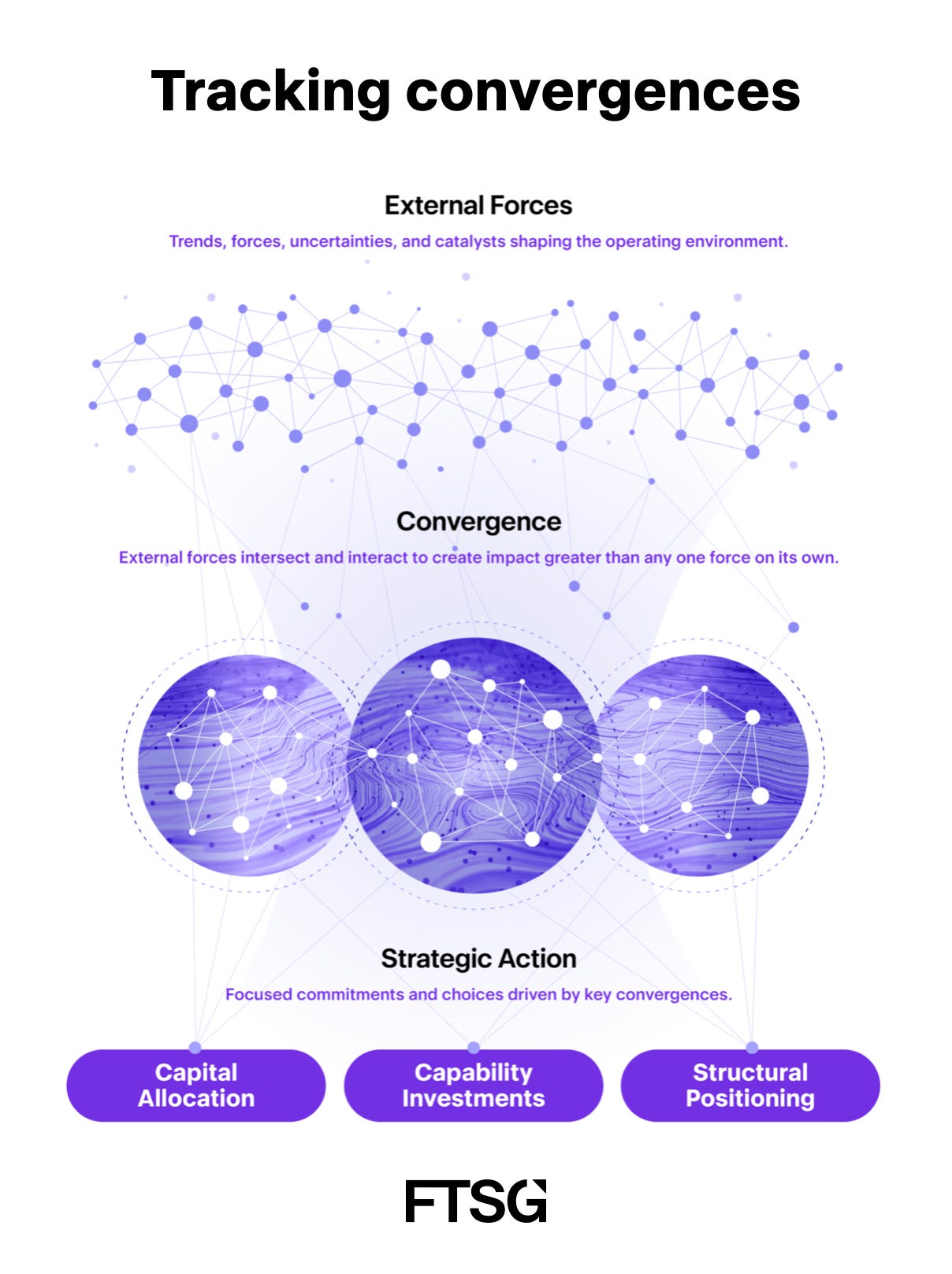
In my field — strategic foresight — we know what to do with a trend. One appears, we track it, we fold it into scenarios, we stress-test it. For us, trends are raw material. But a trend in the hands of someone who isn't running that strategic foresight process is something else: a single reading mistaken for a forecast. It tells you the temperature and lets you believe you understand the weather. That's the trap — not the trend itself, but the false confidence it hands a leader who tracks it and stops there. Which is why, if you're the one making the call rather than the one building the scenarios, the more useful thing to track isn't the trend but the convergence. You don't react to a convergence. You position ahead of it.
A trend tells you what’s changing. A convergence tells you what’s about to become inevitable, before it looks inevitable to anyone else. The window to act opens earlier, and the cost of missing it runs far higher, because by the time a convergence is obvious, the people who saw it early have already taken the ground.
Which is why a convergence is something you put to actual use. You hold it up against whatever you’re building and decide whether to accelerate, to pause, or to reframe the thing entirely.
Here is the working definition I created:
A convergence is what happens when multiple trends, forces, uncertainties, and catalysts intersect and interact to create a combined impact that is greater—and often different in kind—than the sum of their individual effects.
In practice, a real convergence has four characteristics.
First, it’s system-level. Convergences don’t just pile trends on top of each other.
They operate across different domains, making them hard to see unless you are doing a specific type of cross-domain analysis.
Second, it creates new realities suddenly. What seemed inconceivable becomes inevitable, not gradually but suddenly, even though all the pieces were visible beforehand.
Third, it redistributes power and value. Convergences influence who wins, what’s valuable, and where there is leverage. They rewrite competitive dynamics, not just within industries but across them.
Fourth, it’s hard to reverse. Because multiple systems reinforce each other, convergences establish new market realities faster than traditional changes, making early detection increasingly critical.
Here’s a convergence I’ve been tracking. Last year I identified a convergence I call Living Intelligence: the collision of artificial intelligence, advanced sensors, and biotechnology into systems that can sense, interpret, and respond to the living world in real time. The data moves in both directions: the system reads the living world, and it acts back on it. On its own, each of those three technologies is a trend you could put on a roadmap. Together, they are a storm system, and the implications reach into nearly every industry I can name.
Here's the good news buried in all of this: convergences are only invisible until you start looking for them. The storm doesn't announce itself. It assembles from what’s already sitting in plain sight. You don't need to predict it. You need to start tracking it — early, and on purpose.
Each year my team at FTSG publishes the Convergence Outlook, a deep analysis of the convergences we're tracking most closely — what's driving them, who they reshape, and how fast. You can read highlights or download the whole Outlook for free here.
I asked Grok how to make a million dollars in one day…lottery ticket was the answer and some other crazy scenarios. It was a few weeks before Christmas I was sitting in a Target parking lot picking up a gift and as I was sitting in my car asking AI such a question, my mind connected somehow with an idea.
Born 85’, played SimCity in 95’ for the very first time and it changed my life, fast forward 24’ I read Jekyll Island, The Big Print, Broken Money and start to learn crypto.
Once I learned about tokenization, The Amundi Dec. 25’ report fell in my lap during my searches. My eyes became wide as I squinted to concentrate on understanding what was coming this next decade.
There is 48.2 acres adjacent to the old mill in my town here in Georgia. The buildings have been updated but the plot of land has set vacant for the 5 years I’ve lived here.
Boom it hits!!
I research Will Wirght who is the creator of Sim City and then I come to find he thoroughly studied Urban Dynamics by Jay Forrester. Wow there was so much depth that was now being dug up by my curiosity.
And of course the next logical step was hey what would it take to Bring SimCity to the Real World?
I couldn’t get it out of my head that as I played the game the city told me what it wanted. I balanced the budget, demand bars laid the path for me, the algorithm did but hey I was making a city for people. They told me what they wanted. A DAO
You were on with Peter McCormack, whom I watch on YouTube, and I was what you would call a Thinker. Not a Not-Thinker. Right, yeah think that’s right.
So, I subscribed today and my browsing has lead me here to this convergence. Here to say hello and find a way to keep the pyramid, break the k-shaped economy, help everyone own real estate assets, vote on what gets built in the respective county.
Thank you for being on his show. It was a pleasuring hearing you out.
In good fashion and high hopes,
Daniel Emery