

In the spring of 2010, a team working under Craig Venter took a bacterial genome they had written on a computer, assembled it out of bottles of chemicals, and slipped it into an emptied cell. The cell woke up and started to divide. Every descendant carried a watermark the team had encoded into the DNA itself — the names of the scientists who built it, an email address, and a line borrowed from Richard Feynman: “what I cannot build, I cannot understand.”
That organism was a new form of life. Made out of the same building blocks life has always used, but arranged into an order that has never existed.
Chances are good you didn’t notice. (That’s less about you and more about news editors — biology discoveries don’t typically make headline news.) President Obama asked his bioethics commission to take a look and they produced a report; journalists went back to arguing about whether Facebook was ruining democracy.
Venter died this past April at 79, and most of the obituaries led with the human genome race — the sailboat, the swagger, the standoff with Francis Collins. The synthetic cell landed near the bottom, in the paragraph before the survivors.
Hold onto that footnote for the next few minutes as you read on.
A few nights ago I was climbing a steep staircase in Lisbon when a text came in from a researcher friend at Stanford. I told my family to go ahead to dinner and said I'd catch up. A team in California had designed viruses that exist nowhere in nature, built them, and watched them work.
It’s the first proof that a generative model can compose an entire functional genome. I’m not talking about a gene, or a protein — but a complete instruction set for a self-replicating biological entity, written end to end by AI and viable when synthesized in a lab.
If you’ve been reading me for a while, or if you’ve seen me speak about the frontiers of AI and biology anytime in the past two years, this research and the people behind it will already be familiar. The work comes out of Brian Hie’s lab at Stanford and the Arc Institute — the group that built Evo and then Evo 2, a genome language model trained on roughly 9 trillion nucleotides of DNA spanning every domain of life. I’ve described it before as genBio — a ChatGPT for biology, which undersells it slightly. But it doesn’t just predict the next word. It predicts the next base pair.
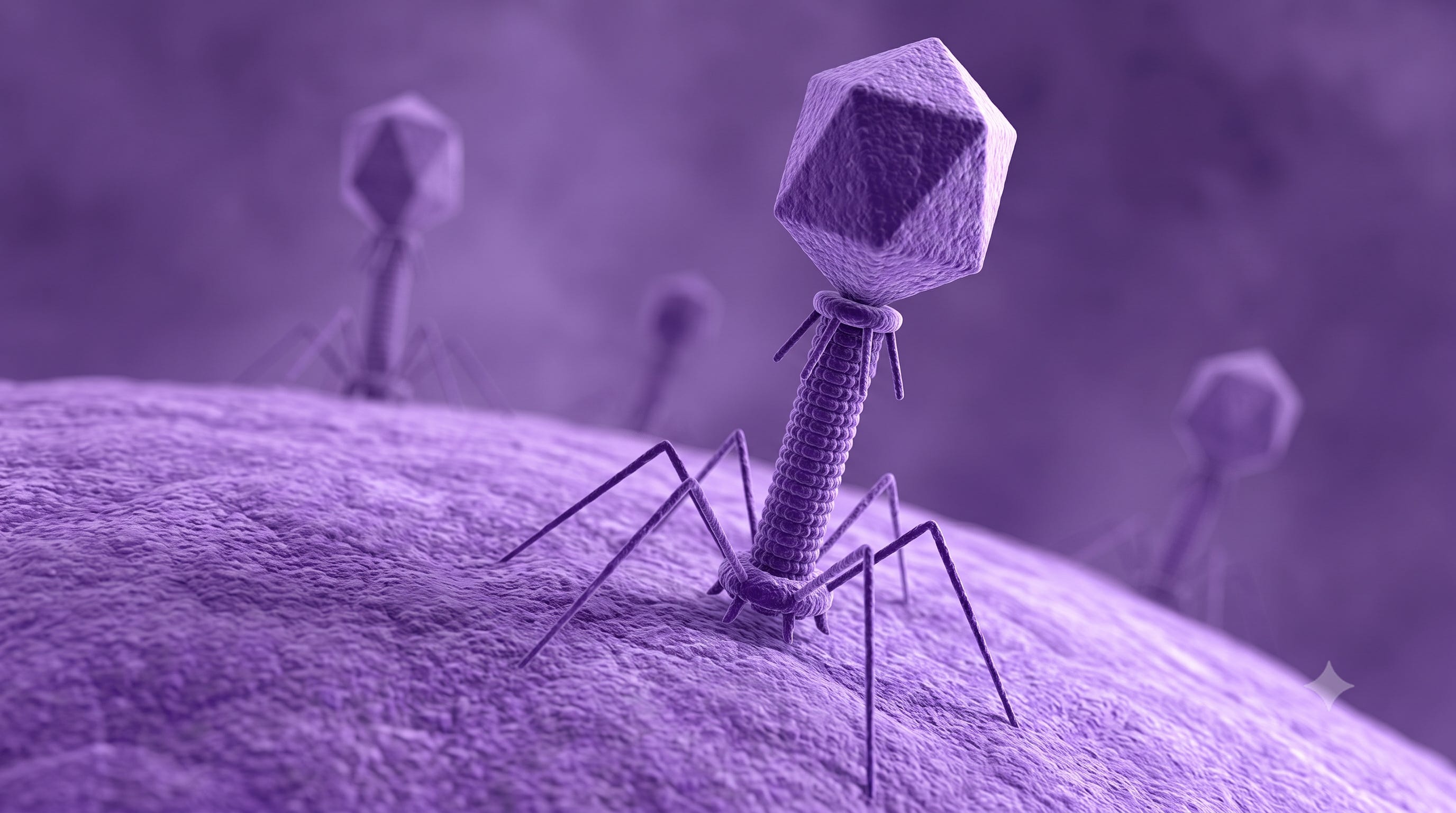
Hie’s team aimed Evo at a single target: ΦX174, a phage that infects E. coli. Phages are viruses that eat bacteria, and doctors already use them as a kind of benevolent predator — mostly as a last resort, against severe drug-resistant infections that antibiotics can no longer touch.
They handed the model an opening fragment and asked it to write the rest, start to finish, in a single pass, without a human in the loop. Thousands of potential genomes came back. The team narrowed the field, chemically built about 300, and tested them in containment. Remarkably, 16 came out alive.
Several killed E. coli faster than the natural phage they were modeled on. Some were so different from anything on record they’d count as new species. One had assembled itself using a structural part borrowed from a distant relative — a solution nobody specified and nobody expected. And a mixture of the AI phages wiped out three strains of E. coli that had already learned to resist the original, which was interesting because a mixture of natural phages couldn’t do that.
It’s hard not to see this as synthetic biology’s “Attention Is All You Need” moment. That 2017 paper introduced the transformer architecture in AI, and it effectively catapulted AI from a sci-fi fantasy into scalable, commercial use. What Hie’s team has published in the journal Science is no less important. Whole-genome generative design is now an engineering problem rather than an open question, and engineering problems, I think, will eventually get solved on a schedule — rather than waiting and hoping for a research breakthrough. In fact, the authors say as much. They describe this as a foundation for designing larger and more complex genomes. (ΦX174 was chosen because it is small.)
Now that we can both edit and write life… what might we design?
Your head might immediately go to novel viruses — the dangerous kind. To their credit, the Stanford and Arc researchers excluded viruses that infect humans, animals, plants and fungi from their training data. They worked only with harmless laboratory strains, consulting biosafety experts throughout and red-teaming the model’s outputs. Writing in the same issue of Science, biosafety researchers from Johns Hopkins said that this team focused on safety more deliberately than most developers of powerful biological AI.
That’s both a compliment and a concern. Voluntary care by conscientious scientists is, at the moment, our entire safety architecture.
Downstream, things get more complicated. For example, once you design something you need to get it biologically printed, a process known as synthesis. Order genetic material and the supplier compares your sequence against databases of known pathogens and controlled agents. That works as long as you’re looking for a known pathogen — what, though, of a novel sequence that doesn’t look like anything on earth?
The way we regulate genBio in the US is a bit of a mess. There is no single American law covering the convergence of genetic engineering, synthetic biology and AI. What exists instead is agency guidance, and guidance is not authority. There is a 2024 screening framework that basically applies only to federally funded work. An executive order in May 2025 gave the White House science office 90 days to revise it; as of last month the Congressional Research Service couldn’t establish whether that had been done. Five bills are now circulating in Congress, each with a different theory of the problem.
I wrote about the lack of alignment and foresight in The Genesis Machine, my book on the convergence of AI and biology. Over the past four years I've been in rooms with members of Congress, the Defense and State Departments, and the White House Office of Science and Technology Policy, showing them scenarios for genBio and its potential impact on everything from national security to the future of our food supply. To date, the most coherent standards in existence belong to an industry consortium, and joining is optional.
Some future scenarios sound pretty great: imagine designing organisms that eat forever chemicals, crops that make their own fertilizer, phage cocktails designed overnight for just one patient’s specific infection. The catastrophic futures include self-replicating things we cannot recall, sequences so novel that we lose the ability to prove an outbreak was engineered — or prove it wasn’t. Attribution is what deterrence rests on, and nothing has to be released for its loss to destabilize the world.
Venter’s team encoded Feynman’s line into a living genome because they believed it. But Feynman's actual line was what I cannot create, I do not understand. Venter's team encoded a slightly garbled version into the genome… so the first watermark on synthetic life contained a human-made transcription error.
Sixteen years on, a model that understands nothing wrote a genome that works — including a structural trick its designers never anticipated and had to go looking for after the fact. Which means Feynman’s premise has been inverted.
We can now build what we do not understand.
I don’t think that’s a reason to stop. But I do think it's a reason to decide, deliberately and soon, what we want written. Because the writing has already started, and the only question left is how seriously we’re all contemplating the newest drafts of life.