


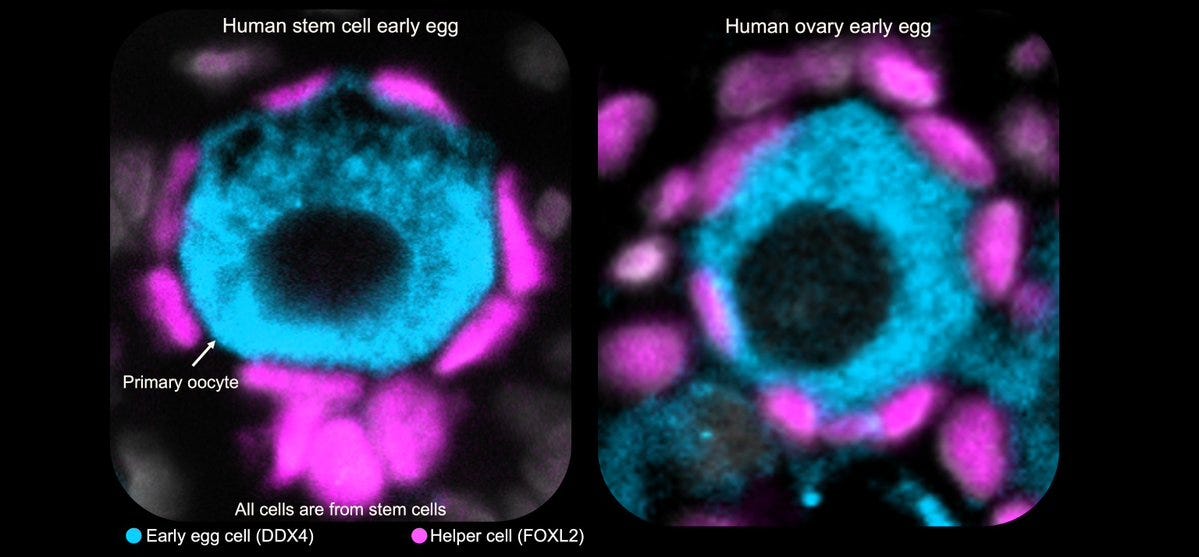
We're one step closer to generating human eggs without a womb, a body, or a donor. Emphasis here is on step. A biotech company just announced a milestone that’s big (if true)… but also somewhat oversold.
Conception, a biotech startup based in the US, just announced that it made human egg cells from blood. Take a donor’s blood, reprogram the cells into stem cells, coax them inside a lab-grown “mini-ovary,” and out come early human eggs. If that sounds like the opening of a story where reproduction detaches from the body entirely, it is. That’s why I’m flagging it.
But read the claim carefully, because the gap between what happened and what was announced is the whole lesson in reading a signal. Conception didn’t actually make eggs. It made primary oocytes — the earliest egg-cell precursors, nowhere near mature enough to fertilize. The news arrived by company blog and a CEO’s social post, not peer review. There’s no published data yet on efficiency, genetic normality, or safety. Clinical use is likely years and many animal studies away.
(If the miracle of “just a few X of blood” has you thinking Theranos, you’re not the only one.)
To be sure, there is a massive body of work already in progress in induced pluripotent stem cells (iPSC). Basically: researchers take a fully committed adult cell — a skin cell, a blood cell, a cell that long ago decided what it was going to be — flip a small set of genes, and reverse it into a blank slate that can become anything.
Most of this is happening in Japan, where I lived and worked for many years. I still visit regularly to meet with researchers working in biotech, robotics and AI. Mitinori Saitou’s team at Kyoto University has been pushing human stem cells toward the egg lineage inside lab-built ovaries since 2018. Recently in 2023, Katsuhiko Hayashi, who is a pioneer in generative reproduction, took skin cells from a male mouse, reprogrammed them into stem cells, got the cells to shedding their Y chromosome and to double the X, and grew them into functional eggs. Fertilized with sperm and carried by surrogates, those eggs produced healthy pups with two biological fathers. The success rate was punishing — only 7 live pups out of 630 embryos — but the team said that doing something similar in humans was likely on a decade away.
Immature cells in a dish are noise, if you’re reading one headline. They’re a signal, if you’re watching the field. What’s on our horizon: a world where an egg can come from anyone’s cells: two fathers, a sixty-year-old, a single person, a nearly unlimited supply.