
In 2017, while I was drafting the future scenarios that became The Big Nine, the best generative music system in the world could produce about 10 seconds of plausible piano, and that was Google’s Magenta which made tinny loops that sounded like a music box with a head injury. WaveNet was only a year old. Nobody I knew in machine learning would have told you, on the record, that a computer would write a convincing rock song in your lifetime.
So I wrote this:
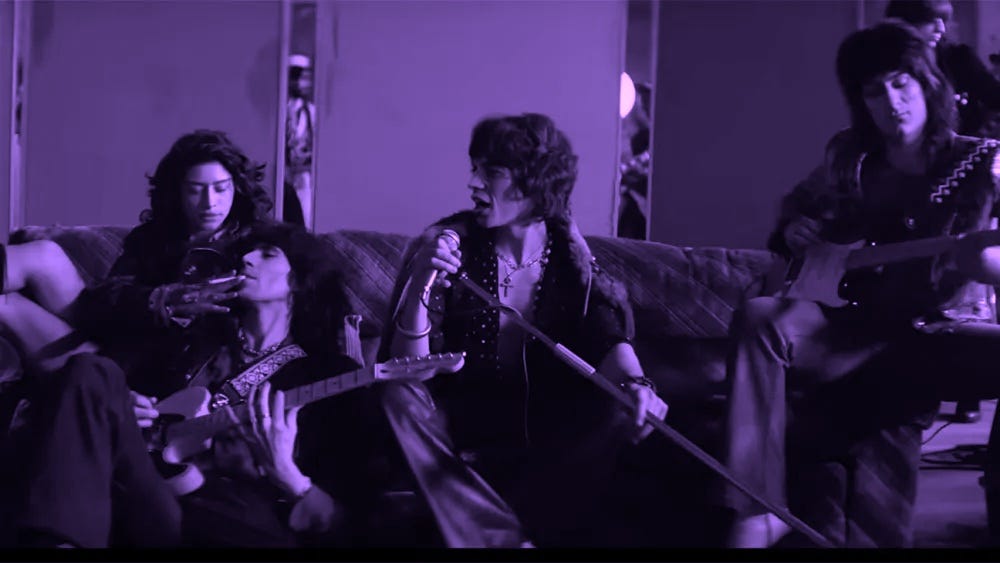
The original members of the Rolling Stones died years ago, but thanks to replicating algorithms, they’re still making new music. That sensation you felt after hearing the first 30 seconds of “Paint It, Black” for the first time—the melancholy guitar melody, followed by eight loud bangs on the drum and a repetitive hook that culminates in Mick Jagger singing “I see a red door and I want it painted black...”—was a singular moment of excitement and satisfaction. It didn’t seem possible you might get to feel that way again with a new Stones song, and yet their latest track is just as loud, hard and fulfilling.
Nine years later, an AI-generated country act called Breaking Rust topped a Billboard sales chart. An AI persona named Xania Monet became the first synthetic act to land on a radio airplay chart and then signed a multimillion-dollar record deal. As of today, LA-based rapper Fenix Flexin is denying that his hit new single was AI-generated after extensive allegations were made.
But what of the Rolling Stones?
Well, drummer Charlie Watts died in 2021… and appears on a Rolling Stones album, Foreign Tongues, released three weeks ago. And, John Lennon, who died in 1980, sings lead on a new Beatles single that won a Grammy.
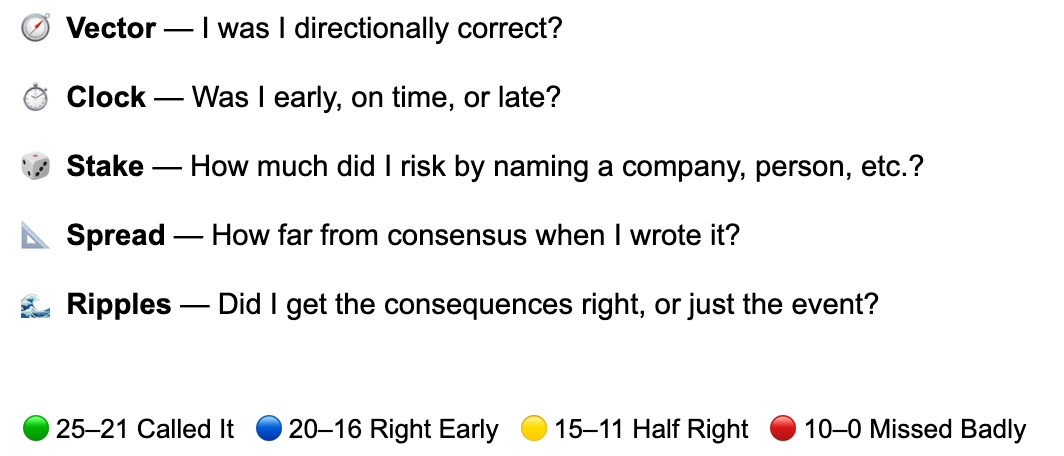
My Scorecard
🧭 5 · ⏱️ 4 · 🎲 5 · 📐 5 · 🌊 2 = 21/25, 🟢 Called It
Analysis
Directionally, I was correct. I was mostly on time, I named a specific band and I was definitely not part of the consensus.
Charlie Watts is on Foreign Tongues because he recorded those takes before he died. One song on that album, “In the Stars,” is a deepfake of four living human people in a real room, whose faces have been swapped with de-aged band members. The Beatles track exists because a neural network pulled Lennon’s actual voice off a degraded 1979 cassette he recorded in his apartment. (Ringo Starr has said flatly that they would never fake John’s vocals.)
Both cases involved AI, but in replication rather than pure generation. The distinction sounds academic until you notice that it has become the entire legal architecture of the industry: California now requires explicit estate consent before an AI replica of a deceased performer can be used commercially. Notice, the rule is about “estate” consent, which means that a decision that my have run counter to someone’s personal wishes can still be made posthumously. That’s why there’s a new Prince album out now, which I have to think he’d have hated.
I was right about the technology and hilariously wrong about the band. I literally have no idea how or why, given their history… but Mick Jagger (82), Keith Richards (82) and Ronnie Wood (79) are still very much alive and still performing on stage.
Methodology
Each scored 1–5. Total out of 25.